2025’s Best CRMs for Nonprofits and Credit Unions Reviewed

Nonprofits and credit unions face unique challenges in managing donor relationships, member engagement, and regulatory compliance while operating with limited resources. The right customer relationship management (CRM) system can transform how these organizations connect with their communities, streamline operations, and achieve their missions. This comprehensive review examines the leading CRM solutions for 2025, evaluating their features, pricing, and suitability for mission-driven organizations. From budget-friendly options to enterprise-level platforms, we’ll help you identify the best CRM for donor management and member engagement that aligns with your organizational needs and budget constraints.
Overview of CRM Needs for Nonprofits and Credit Unions
Customer Relationship Management (CRM) serves as a technology platform that centralizes and manages interactions, data, and workflows related to customers, donors, or members, aiming to boost engagement, retention, and operational efficiency. For nonprofits and credit unions, these systems become the backbone of organizational success.
Mission-driven organizations rely heavily on CRMs for comprehensive fundraising campaigns, detailed donor and member management, relationship-building initiatives, compliance tracking, and integrated communications across multiple channels. Unlike traditional businesses, these organizations must balance relationship nurturing with strict regulatory requirements and transparent reporting standards.
Modern CRMs must deliver sophisticated automation capabilities, data-driven insights, and seamless integrations to support complex organizational missions. The most effective nonprofit CRMs combine traditional relationship management with specialized tools for grant tracking, event management, and volunteer coordination. Understanding these CRM needs for nonprofits and credit unions is essential for making an informed selection that will serve your organization’s long-term growth.
Key Features to Look for in Nonprofit and Credit Union CRMs
When evaluating CRM systems, nonprofits and credit unions should prioritize features that directly support their unique operational requirements. Essential capabilities include comprehensive donor and member management systems, robust event and fundraising tracking, intelligent workflow automation, detailed reporting and analytics, integrated marketing tools, compliance support mechanisms, and seamless integration with external applications.
Workflow automation represents tools in a CRM that allow organizations to automate repetitive tasks, such as email follow-ups, member renewals, or donation receipts, to improve efficiency and reduce manual work. This automation becomes particularly valuable for organizations with limited staff resources.
| Must-Have Features | Advanced Features |
| Donor/Member profiles | AI-powered insights |
| Fundraising tracking | Predictive analytics |
| Email marketing | Advanced segmentation |
| Basic reporting | Custom dashboards |
| Contact management | API integrations |
| Task automation | Multi-channel campaigns |
The landscape is rapidly evolving toward AI CRM for nonprofits, where artificial intelligence enhances decision-making through predictive analytics, automated lead scoring, and intelligent campaign optimization. Leading CRM platforms now incorporate machine learning algorithms that help organizations identify major gift prospects, predict member retention rates, and optimize communication timing for maximum engagement.
SugarCRM: Comprehensive Solution for Nonprofits and Credit Unions
SugarCRM stands out as a leading contender for mission-driven organizations in 2025, offering robust capabilities that unite sales, marketing, and service teams under a single platform. The system provides customizable features and the capability to unify donor, member, and operational data into actionable insights.
Organizations seeking extensive automation, analytics, and workflow customization find SugarCRM particularly well-suited to their needs. The platform excels as a top choice for donor management and member engagement by providing comprehensive tools that scale with organizational growth while maintaining cost-effectiveness.
AI-Driven Insights and Workflow Automation
SugarCRM offers AI-powered tools that streamline processes, predict outcomes, and deliver actionable insights that support both operational efficiency and donor/member engagement strategies. The platform’s AI-powered CRM capabilities use machine learning and analytics to uncover actionable trends in donor and member data, recommend next steps, and reduce manual analysis for staff.
SugarCRM’s workflow and process automation tools can be configured to handle a wide range of tasks, such as sending follow-up messages when certain donation or engagement criteria are met, triggering onboarding notifications when a new member record is created, and routing incoming cases to the right team based on predefined rules. These automations help organizations ensure timely communication and more consistent, efficient service across teams.
Customer Service and Reporting Capabilities
The platform includes built-in customer service reports that provide granular analytics, allowing nonprofits and credit unions to monitor key performance indicators, assess donor or member health, and track support issue resolution. This advanced reporting capability proves essential for compliance requirements, grant applications, and continuous improvement initiatives.
Customizable reporting features enable organizations to create sector-specific dashboards that track metrics such as donor retention rates, average gift sizes, member engagement scores, and campaign performance across multiple channels.
Usability and User Experience
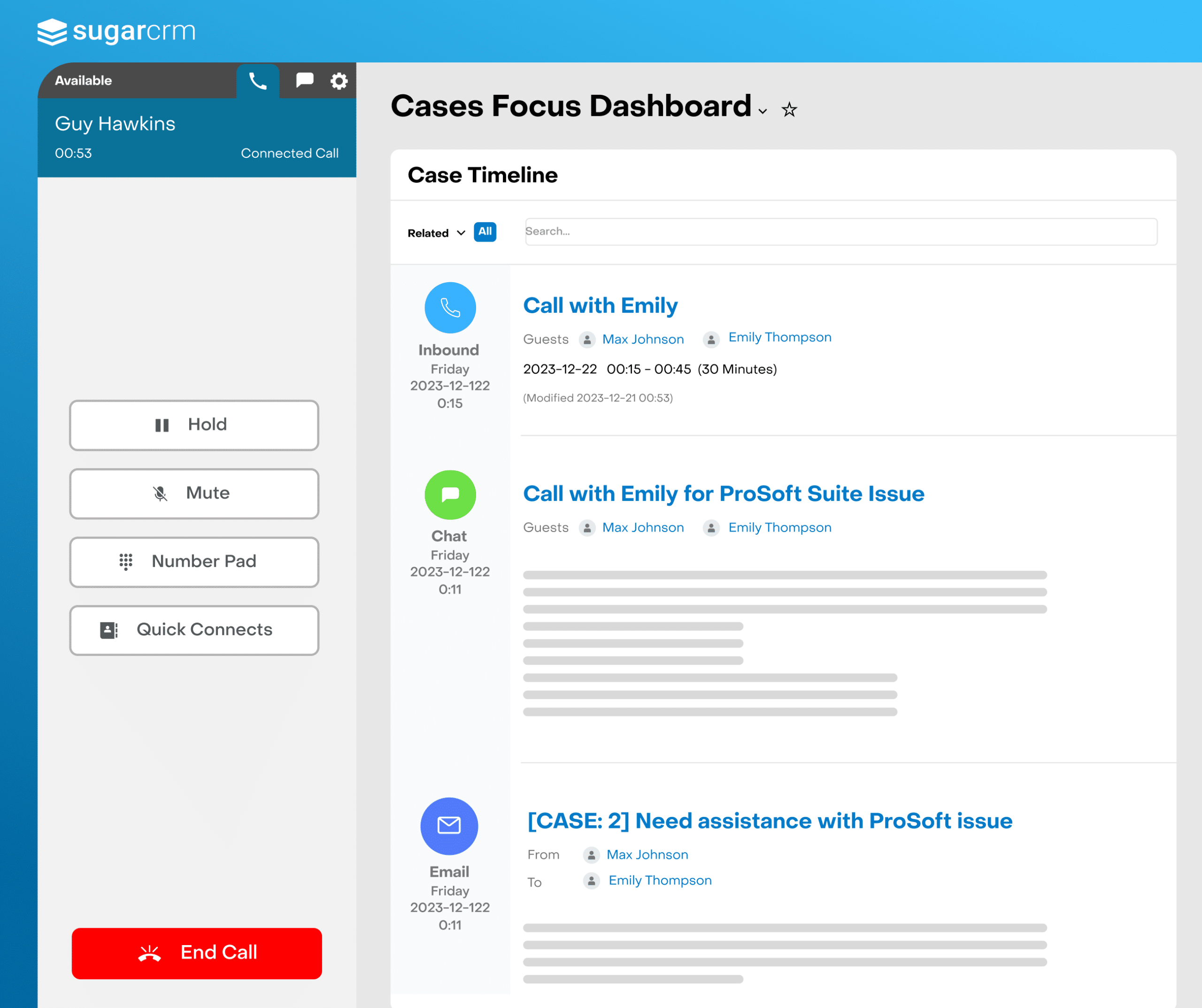
SugarCRM supports strong usability through role-based views and customizable dashboards that surface the most relevant information for each user. Nonprofits that take time to tailor layouts, automate routine tasks, and provide focused training typically achieve higher user adoption and stronger overall value from their SugarCRM implementation.
Zoho CRM: Budget-Friendly with Core Capabilities
Zoho CRM presents an attractive option for smaller organizations or those operating with constrained budgets. The platform offers a free tier, making it an accessible entry point for small nonprofits beginning their CRM journey.
This entry-level CRM solution provides core features suitable for growth without initial complexity, including AI assistance through Zia for data insights, straightforward setup processes, and solid integration capabilities. However, organizations requiring deeper customization may find limitations compared to more robust platforms like SugarCRM.
Zoho’s strength lies in its simplicity, making it ideal for organizations with basic donor management needs and limited technical resources for complex implementations.
Microsoft Dynamics 365: Enterprise-Level Customization and Integration
Microsoft Dynamics 365 targets larger organizations requiring sophisticated customization and deep integration within the Microsoft ecosystem. This enterprise CRM system serves complex, multi-departmental organizations that require customized workflows, integrations, and advanced security controls.
The platform’s configurability and integration strengths make it powerful for large nonprofits or credit unions with complex operational requirements. However, the system demands significant resources for implementation and ongoing maintenance, making it less suitable for smaller organizations with limited IT support.
Organizations already invested in Microsoft technologies often find Dynamics 365 provides seamless integration with existing tools and workflows, though the complexity requires dedicated technical expertise.
HubSpot CRM: Marketing-Focused and Easy to Use
HubSpot CRM positions itself as an ideal solution for nonprofits and credit unions emphasizing inbound marketing and rapid user adoption. The platform offers a free entry plan with straightforward setup processes, while paid tiers scale to accommodate growing organizational needs.
The system excels in marketing automation, campaign tracking, and implementation simplicity, making it particularly attractive for organizations prioritizing digital marketing and online engagement. However, costs can escalate quickly as organizations require more advanced features, potentially making it less cost-effective than initially anticipated.
HubSpot’s user-friendly interface and comprehensive marketing tools make it an excellent choice for organizations with a strong digital marketing focus and limited technical expertise.
Nimble CRM: Social Media and Community Engagement Emphasis
Nimble CRM differentiates itself through robust social media integration and streamlined relationship management capabilities, with pricing accessible for small teams. The platform excels for nonprofits and credit unions that rely heavily on online community-building and social media engagement as primary relationship-building tools.
Organizations emphasizing social media outreach, community engagement, and relationship nurturing through digital channels find Nimble’s specialized features particularly valuable. However, more sophisticated organizations may need to evaluate potential gaps in advanced fundraising tools or comprehensive compliance features.
The platform’s social-first approach makes it ideal for digitally native organizations that prioritize online community building over traditional relationship management approaches.
Comparative Analysis of CRM Pricing and Feature Sets
| CRM Platform | Donor/Member Tools | Automation | Reporting | Marketing | Integrations | Unique Strengths | |
| SugarCRM | Comprehensive | Advanced | 60+ built-in | Integrated | Extensive | AI insights, customization | |
| Zoho CRM | Basic | Moderate | Standard | Good | Moderate | Affordability, Zia AI | |
| Microsoft Dynamics | Enterprise | Advanced | Extensive | Advanced | Deep Microsoft | Enterprise scale, customization | |
| HubSpot | Good | Strong | Good | Excellent | Moderate | Marketing focus, ease of use | |
| Nimble | Basic | Limited | Basic | Social-focused | Limited | Social media integration |
This comparison reveals that the value proposition depends heavily on organizational size, technical requirements, and specific use cases.
Choosing the Right CRM Based on Organizational Needs
Selecting the optimal CRM requires a systematic CRM selection process—a structured approach to evaluating, comparing, and testing CRM platforms based on specific organizational goals, resources, and growth trajectory. Organizations should begin by inventorying current operational challenges, clearly defining must-have features, scoring potential CRMs using a weighted evaluation matrix, and conducting pilot programs with top contenders.
The selection process must balance long-term growth needs against current technical capacity and budget constraints. Organizations should carefully evaluate not just initial costs but also scaling expenses, integration complexity, and hidden fees that may emerge as usage grows. This comprehensive approach helps identify the best CRM for credit unions and nonprofits that aligns with both immediate needs and future organizational development.
Consider factors such as staff technical expertise, existing software ecosystem, compliance requirements, and growth projections when making your final decision. The right CRM should enhance rather than complicate your organization’s mission delivery.
Frequently Asked Questions
What essential features should nonprofits and credit unions prioritize in a CRM?
Must-have features include comprehensive donor or member management capabilities, fundraising and campaign tracking, intelligent workflow automation, customizable reporting and analytics, integration with key platforms like accounting and marketing tools, and built-in compliance support to meet regulatory requirements.
How do CRM pricing models typically work for nonprofits and credit unions?
Most CRM providers offer tiered, per-user monthly pricing structures, with many granting special discounts or nonprofit packages. This subscription model allows organizations to scale features and user access as needed while maintaining predictable monthly costs for budget planning.
What are common challenges during CRM implementation and how can they be addressed?
Common challenges include user adoption resistance, complex data migration from existing systems, and configuration complexity. Solutions include comprehensive onboarding processes, dedicated vendor support during transition periods, thorough user training programs, and phased implementation approaches that minimize disruption.
Can CRM systems integrate with popular nonprofit and credit union tools?
Yes, leading CRMs, including SugarCRM, are specifically designed to integrate with major platforms such as accounting software, fundraising tools, event management systems, email marketing platforms, and financial services applications to create streamlined operational workflows.
How do CRMs ensure data security and compliance for sensitive member or donor information?
Top CRM platforms feature built-in security protocols including data encryption, role-based access controls, audit trails, and compliance tools designed to help organizations safeguard sensitive information and meet regulatory requirements such as PCI DSS for credit unions and donor privacy regulations for nonprofits.